


Novelty party sunglasses are not automatically UV protected: rely on an explicit UV400 or 100% UVA and UVB protection claim for the exact pair, not its appearance. Dark lenses, printed patterns, and see-through designs do not prove UV protection, so choose verified protective sunglasses for outdoor wear and treat an unverified pair as a photo prop.
- Are party sunglasses UV protected? Only a product-specific UV claim establishes protection; novelty styling does not.
- UV400 describes protection through 400 nanometers; dark tint and polarization are separate features.
- Funglasses party sunglasses suit celebration photos; check the exact pair’s UV information before relying on outdoor protection.
- Choose verified UV protection for outdoor celebrations and keep unverified novelty sunglasses for photo moments.
Are novelty party sunglasses UV protected?
The answer depends on the exact product, not the party-sunglasses category. A novelty pair can have UV-protective lenses, but its shape, occasion label, or colorful graphic does not establish that protection. Read the product information and packaging before you count it as sun-protective eyewear.
For a 2026 outdoor celebration, look for a clear statement covering both UVA and UVB. The U.S. Food and Drug Administration’s consumer guidance recommends sunglasses labeled UV400 or 100% UV protection. The American Academy of Ophthalmology also advises choosing sunglasses that block 99–100% of UVA and UVB radiation.
If you are choosing accessories specifically for pictures, start with sunglasses for photo booth props, then make a separate decision about outdoor protection. A great photo accessory and dependable sun-protective eyewear are different requirements.
| Product information | What it establishes | Best for | Advantage | Limitation |
|---|---|---|---|---|
| Explicit UV400 or 100% UVA and UVB protection claim | A stated UV-protection specification for that pair | Outdoor celebrations, subject to fit and intended use | Gives you a relevant protection claim to check | Does not establish impact protection or suitability for every activity |
| Dark tint without a UV statement | Visible-light shading, not confirmed UV protection | Styling decisions only until protection is verified | Changes how bright the scene appears | Darkness does not tell you how much UV the lenses block |
| Polarized lenses without a UV statement | A glare-reduction feature, not confirmed UV protection | Assessing glare needs after checking UV protection | Addresses reflected glare | Polarization alone is not proof of UVA or UVB protection |
| Printed novelty lenses without a UV statement | A decorative lens design | Celebration photos and photo-booth props | Makes the accessory part of the party theme | A graphic or see-through pattern does not establish UV performance |
Why this matters
You can see tint, but you cannot judge UV filtration by looking through a lens. A pair that makes the scene darker is not necessarily a pair that blocks ultraviolet radiation. Check the protection statement before you judge the color.
That distinction matters when your celebration moves between a reception room, a sunny courtyard, and an outdoor photo spot. Planning the accessories for your 2026 party is straightforward once you separate their jobs: novelty designs support the theme, while verified UV-protective eyewear supports outdoor eye protection.
You do not need to abandon the party look. Keep the decorative pair available for photos and bring verified protective sunglasses for the outdoor portions if the novelty pair’s protection is unconfirmed.
What does UV400 mean on party sunglasses?
UV400 describes protection against ultraviolet wavelengths through 400 nanometers. That cutoff covers the UVA and UVB wavelengths relevant to ordinary sunglass selection. It is a lens-protection claim, not a description of how dark the lenses look.
You will also see wording such as 100% UVA protection and 100% UVB protection. Those statements address the radiation you want the sunglasses to block. A vague phrase such as sun-ready does not communicate the same specification.
For your 2026 shopping checklist, record the exact wording rather than translating a decorative description into a safety claim. If a listing discusses lens graphics but says nothing about UV, you have information about the design—not confirmation of sun protection.
UV400 is not a promise that a pair is suitable for driving, sports, or protective work. Those uses introduce other requirements, including visibility, impact resistance, and intended use. Keep the UV question separate from those questions.
What should the label actually say?
Look for a clear UV400 statement or wording that explicitly identifies protection against both UVA and UVB. Match that statement to the pair you are buying. Do not transfer a claim from another model, another seller, or a photograph of unrelated packaging.
A label is useful because it states the claimed performance. If you need additional assurance, ask the seller for product-specific supporting information or ask an optical professional about testing. A clearly stated claim is the starting point; appearance is not a substitute.
How do you check party sunglasses before buying?
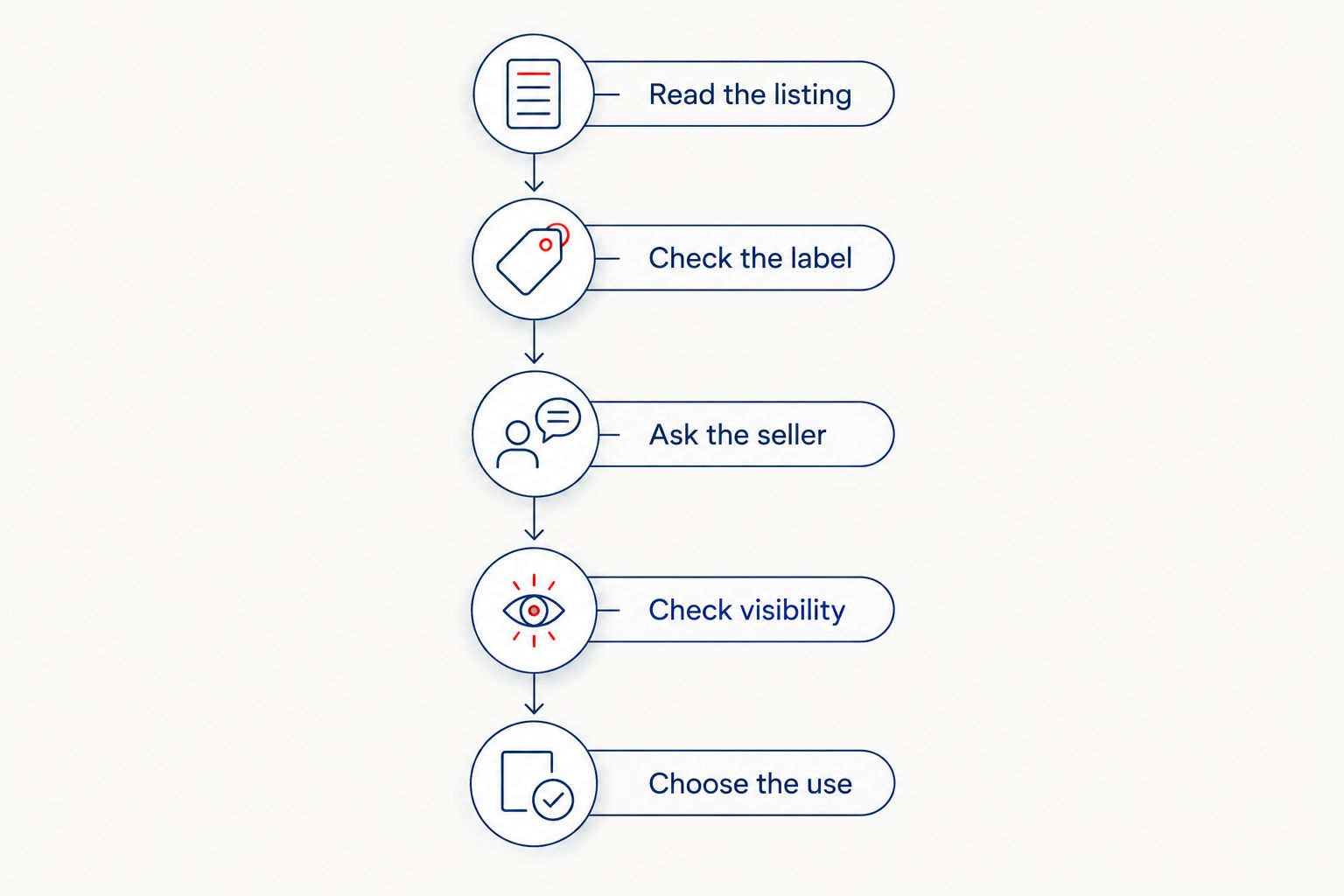
Use the same sequence whether you are shopping for yourself or selecting favors for a whole event. It keeps the design decision from swallowing the protection decision.
- Read the listing. Find the UV statement for the exact product. Look beyond the title, lens color, and occasion description.
- Check the label. Review packaging or included product information for UV400 or explicit UVA and UVB protection wording. Resolve any conflicting claims before relying on the pair outdoors.
- Ask the seller. Request confirmation for that exact design when the wording is unclear. Ask about UV protection directly rather than whether the glasses are good for summer.
- Check visibility. Make sure you can see your surroundings clearly enough for the intended activity. A UV claim does not establish that a patterned lens is appropriate for driving or moving through a crowded venue.
- Choose the use. Use a verified, suitable pair for outdoor wear. Keep a pair with unconfirmed UV protection in the photo-prop role.
The strongest buying question is simple: does this exact pair have a documented UV400 or UVA-and-UVB protection claim? An answer about its style, popularity, or see-through design does not answer that question.
Keep the product information with your event notes if you are ordering favors for a 2026 wedding or group celebration. That gives anyone helping with setup the same information about intended use. Avoid adding your own UV-protected description to a favor sign unless the product’s documentation supports it.
Why UV protection varies between party sunglasses
There is no single UV specification attached to the words party sunglasses. They describe an occasion and a style, not a uniform lens construction. The exact product information determines what protection the seller claims.
These are the distinctions that matter:
- Lens material: Different lens materials have different UV-transmission properties. A frame’s appearance does not identify those properties.
- UV treatment: A lens can use UV-absorbing material or a protective treatment. You cannot confirm either simply by checking its tint.
- Exact product design: A claim must apply to the pair you select. Matching colors or similar frames do not establish matching specifications.
- Decoration versus filtration: A printed graphic describes the look of the lens. It does not, by itself, describe UV filtration.
- Fit and coverage: Verified protective lenses still leave room for sunlight around the frame. The American Academy of Ophthalmology recommends larger or wraparound styles for greater coverage.
Do not assume every novelty pair lacks UV protection, and do not assume every novelty pair has it. Both shortcuts replace a product-specific check with a category-wide guess.
The same discipline applies to wedding favors, holiday accessories, and festival outfits. An occasion name tells you where the design fits. It does not tell you what the lens blocks.
Do darker party sunglasses block more UV?
Darker party sunglasses do not necessarily block more UV. Tint reduces visible light; UV filtration concerns ultraviolet radiation. The FDA’s sunglass guidance makes that distinction, so judge protection by the stated UV specification rather than lens darkness.
A dark pair can feel comfortable in bright light without giving you evidence about UVA or UVB filtration. Conversely, a lighter-looking lens can have a UV-protection claim. You need the specification to distinguish those situations.
Do not use a quick look through the lens as a home UV test. Seeing a darker scene tells you about visible light reaching your eyes, not the ultraviolet radiation being filtered.
Does polarization mean party sunglasses are UV protected?
Polarization does not establish UV protection. Polarized lenses address reflected glare; a separate UV claim establishes the stated ultraviolet protection. Check both features if you want both benefits.
This is especially relevant when you are planning a poolside or boat-side celebration. Reflections can make glare reduction useful, but polarized wording alone does not answer the UVA-and-UVB question. Start with verified UV protection, then consider glare, fit, and the activity.
Neither polarization nor UV400 automatically makes a novelty pair suitable for sports or driving. Use eyewear intended for the activity rather than treating a single feature as approval for every setting.
Do patterned or see-through lenses prove UV protection?
A patterned or see-through lens does not prove UV protection. Those descriptions explain how the design looks or how you see through it. They do not provide a measured UV specification.
Do not make the opposite assumption either. A decorative pattern alone does not prove that the underlying lens lacks UV protection. The useful question remains whether the exact finished product has a clear protection claim.
For daytime use, check both protection and visibility. If the pattern makes your surroundings harder to see, take the accessory off before walking through a busy space, using stairs, or doing anything that needs an unobstructed view.
How should you plan sunglasses for an outdoor party?
Separate the photo moment from the outdoor-wear requirement. Start by identifying which parts of your event happen outside, then choose eyewear with verified UV protection for those portions. Decorative accessories can still have their own place in the celebration.
For a 2026 garden wedding, that means checking the favors before treating them as guests’ sun protection. For a daytime birthday gathering, it means keeping your dependable outdoor sunglasses available even if you have chosen a themed pair for group pictures.
Use this practical division:
- Outdoor wear: Choose sunglasses with a clear UV-protection claim, a secure fit, and visibility suited to what you are doing.
- Posed photos: Choose the occasion-specific design, then check that everyone can see and move safely while wearing it.
- Indoor celebrations: Treat the glasses as an accessory rather than as necessary sun protection. Remove them if they make the room harder to see.
- Driving or active games: Use appropriate eyewear for the activity. A decorative design and a UV label do not establish activity-specific suitability.
There is no need to invent a safe number of minutes for an unverified pair. A short photo session does not certify its UV performance. Keep the decision tied to verified protection and intended use, not an arbitrary time limit.
Where does Funglasses fit?
Funglasses party sunglasses are best for novelty-gift shoppers and event planners choosing patterned-lens accessories for celebration photos. The brand’s focus includes wedding roles, holidays, birthdays, graduations, Pride, and the 2026 World Cup.
Browse Funglasses for the occasion-specific look, then check the exact pair’s protection information before relying on it outdoors. The benefit is a graphic accessory that makes the occasion part of the photo; the limitation is that a party-focused design is not evidence of UV performance.
Keep those two decisions separate. Choose the design because it fits your celebration, and choose outdoor eye protection because its product information supports that use.
FAQ
Are party sunglasses UV protected?
Party sunglasses are not automatically UV protected. Check the exact pair for UV400 or explicit 100% UVA and UVB protection wording; its novelty design does not establish protection.
What does UV400 mean on sunglasses?
UV400 describes protection against ultraviolet wavelengths through 400 nanometers. It concerns UV filtration, not lens darkness, polarization, or impact resistance.
Do dark novelty sunglasses protect my eyes from UV?
Dark novelty sunglasses do not prove UV protection. Tint reduces visible light, so check a separate UVA-and-UVB protection claim before relying on the pair outdoors.
Are polarized party sunglasses automatically UV protected?
Polarized party sunglasses are not automatically UV protected. Polarization addresses reflected glare, while a separate UV specification states ultraviolet protection.
Can I tell whether sunglasses have UV protection by looking through them?
You cannot determine UV protection by looking through sunglasses. Read the product-specific protection information, and ask an optical professional about testing if you need further confirmation.
Are Funglasses party sunglasses UV protected?
Check the exact Funglasses product’s UV information before relying on it for sun protection. Patterned lenses and occasion-specific designs do not establish a UV400 or UVA-and-UVB protection claim.
Can children use novelty party sunglasses instead of protective sunglasses?
Do not substitute an unverified novelty pair for children’s UV-protective sunglasses outdoors. Choose documented UV protection and an appropriate fit, and supervise decorative accessories during photos.
Can I wear UV400 party sunglasses to watch a solar eclipse?
Ordinary UV400 sunglasses are not safe for looking directly at the sun or watching a solar eclipse. Use appropriate solar-viewing protection; ordinary sunglasses are not a substitute.
One last thing
The clearest lens is not necessarily the least protective, and the darkest lens is not necessarily the most protective. Visible tint and ultraviolet filtration are different properties. That is the useful fact to remember when a bold design catches your eye.
Before your next outdoor celebration, make one final check: find the UV statement for the exact pair. If you cannot confirm it, keep the accessory for pictures and bring verified protective sunglasses for the sunshine. You can keep the party look without guessing about protection!


