


For your 2026 bachelorette party, plan on one pair of sunglasses for every confirmed guest who will wear them, including the bride. Count any shared photo-booth props and deliberate spare pairs separately; a new outfit or another party stop does not automatically require another pair.
- How many sunglasses for bachelorette party photos? Plan one pair per participating guest, including the bride.
- Count take-home favors separately from shared photo-booth props so you do not promise the same pair twice.
- Funglasses party sunglasses suit bachelorette groups that want patterned-lens props for celebration photos.
- Add spares for a specific reason, not an arbitrary percentage of the guest list.
How many pairs of sunglasses do you need for a bachelorette party?
Your starting quantity is the number of confirmed people who will receive or wear a pair. Include yourself if you are organizing and joining the photos. Include the bride unless her pair has already been purchased separately.
For a 2026 bachelorette party, use this planning rule:
Order quantity = assigned guest pairs + separate shared props + chosen spares − suitable pairs already purchased.
This is a planning recommendation, not a survey-based average. You do not need a standard party-size estimate when you have your own guest list.
Work through the count in this order:
- Count guests. List everyone attending the activity where you will hand out the sunglasses.
- Check roles. Mark the bride and any guests receiving a role-specific design.
- Assign pairs. Give each participating guest an allocation, or define a shared photo-prop pool.
- Keep spares. Add only the extras you deliberately want, then subtract purchases already made.
Once the count is settled, use the guide to planning a bachelorette party with matching sunglasses to coordinate the group look.
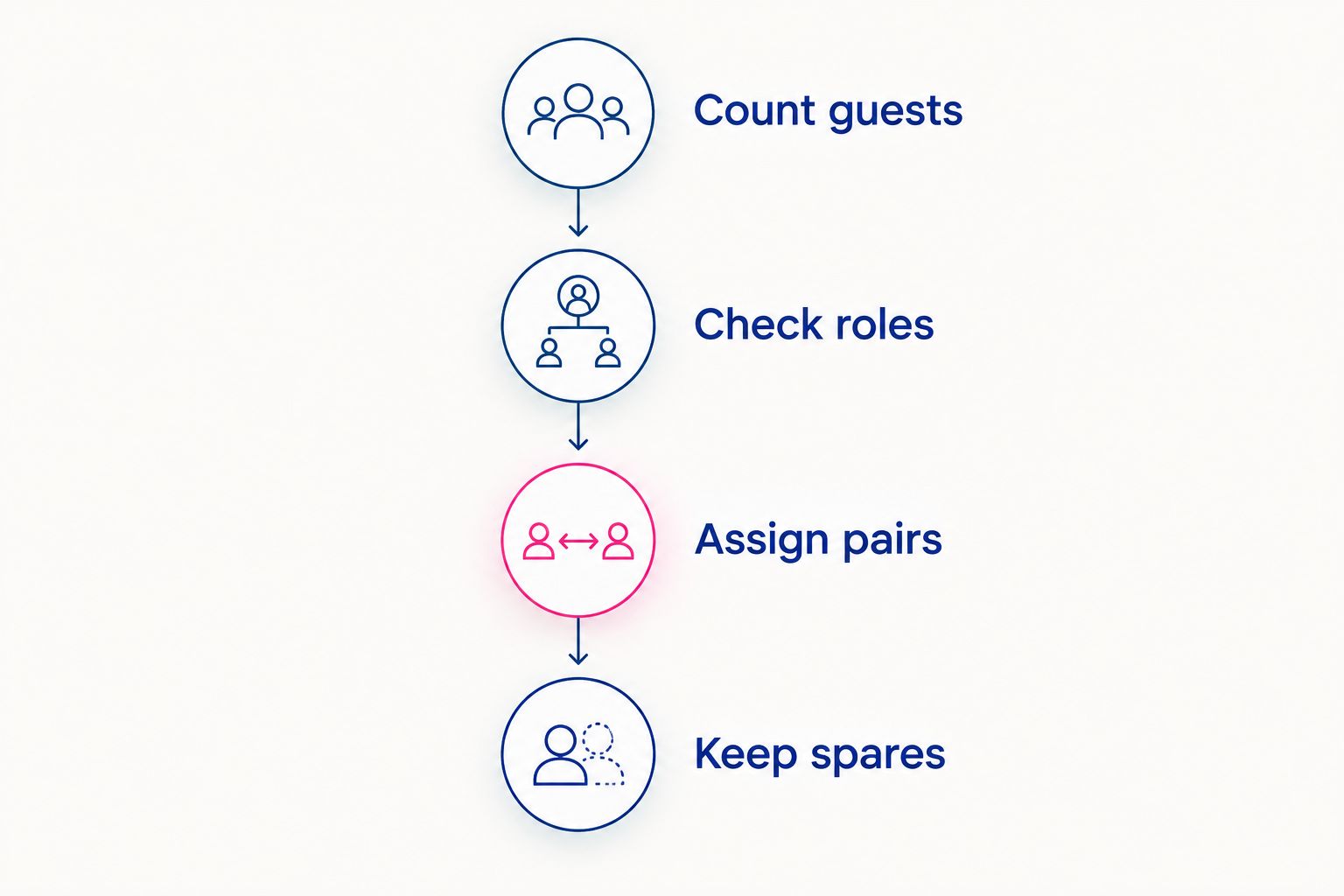
The useful count is the number of pairs with a purpose. A spare belongs in the order because you want a replacement on hand, not because every bachelorette party supposedly needs the same buffer.
Why this matters
Sunglasses can be a personal favor, a shared photo prop, or both. Those plans require different counts, so choose their purpose before choosing the quantity.
A take-home pair stays assigned to its recipient. A shared prop stays with the photo setup. If you promise guests a favor but also expect those same pairs to remain on a prop table, your plan conflicts with itself.
Funglasses party sunglasses are best for bachelorette groups that want patterned-lens props for celebration photos. The occasion-focused look fits that purpose; it does not establish sun-protection performance or replace checking the product details for your intended use.
Personal favors: one pair per participating guest
Best for: a group photo where everyone wears sunglasses together, followed by take-home favors. Assign a pair to each person who wants to participate, with the bride included in the total.
This is the clearest plan when sunglasses go into individual welcome bags. Each bag has an owner, and each owner has a pair. You also avoid relying on someone returning a prop before the next guest can use it.
The trade-off is that your quantity follows the number of recipients, even if some guests wear their pair only briefly. Confirm interest before treating every invitation as an automatic sunglasses allocation.
For your 2026 planning list, record the recipient beside the design. That makes it easier to spot a missing bride pair, a duplicate purchase, or an allocation for someone who is no longer attending.
Recommendation: choose personal favors when simultaneous group photos and take-home gifts are part of the plan.
Shared photo props: one pair per simultaneous wearer
Best for: a photo corner where guests take turns rather than posing as the entire group. Your starting quantity is the largest number of people you want wearing sunglasses in the same shot.
A shared pool separates the prop count from the full invitation list. It also means the props need a home: a designated table, container, or organizer who brings them to the photo spot.
The limitation is straightforward. A pool smaller than the participating group cannot put sunglasses on everyone at once, and shared props are not individual favors unless you later assign them to recipients.
Do not choose a shared pool while promising a fully matching group portrait. Those are different photo plans.
Recommendation: choose shared props when turn-taking is intentional and guests are not expecting their own pair.
Mixed favors and props: count each allocation separately
Best for: a party with personal favors plus a separate photo setup. Give the favor allocation and the shared allocation their own lines in your order list.
This approach lets guests keep their assigned sunglasses while the photo area retains its props. The drawback is extra coordination: someone must know which pairs can leave with guests and which should stay at the setup.
| Allocation plan | Best for | How to set the quantity | Main advantage | Main limitation |
|---|---|---|---|---|
| Personal favors | Everyone wearing sunglasses together | Count participating recipients, including the bride | Clear ownership and take-home allocation | Quantity follows recipient count |
| Shared props | Guests taking turns for photos | Count simultaneous wearers | Quantity follows the photo setup | Not everyone can necessarily wear a pair together |
| Mixed allocation | Favors plus a separate prop station | Add personal allocations and a distinct shared pool | Keeps favor and prop plans separate | Requires clear sorting and handout instructions |
Choose the allocation plan before you choose designs. Matching colors cannot fix a count that assigns the same pair to incompatible purposes.
Why your bachelorette sunglasses quantity varies
The guest list is the starting point, but it is not the entire calculation. These decisions determine what belongs in your order:
- Participation: Count the people who want a pair, not everyone who received an invitation.
- Bride allocation: Include the bride in the recipient total, then identify her design separately.
- Photo format: A full-group portrait requires enough pairs for all participating wearers at once; turn-taking does not.
- Favor ownership: Pairs promised as take-home gifts should not also be counted as permanently shared props.
- Existing purchases: Subtract suitable pairs already bought by you, the bride, or another organizer.
- Replacement plan: Add spares only when you deliberately want replacements or have unresolved recipients to cover.
For a 2026 celebration with changing attendance, keep confirmed allocations separate from undecided ones. That preserves a useful count without pretending every invitation is a final acceptance.
Before submitting the order, ask the other organizers whether anyone has already bought sunglasses. An existing purchase changes the remaining quantity even when your guest list stays exactly the same.
How should you split bride and guest designs?
Start with recipients, then assign the occasion labels. A bride-specific design belongs to the bride's allocation; it is not automatically an extra pair on top of the guest total.
For example, you can consider Funglasses Bride Wedding Party Sunglasses for that allocation. The benefit is a design tied to the bride's role; the limitation is that a bride-specific label is not a neutral choice for every guest or every spare.
Check the intended recipient before choosing role wording. Family roles, wedding roles, and friendship groups are not interchangeable, even when everyone is attending the same celebration.
Use a simple allocation list:
- Recipient name
- Attending activity
- Wants sunglasses
- Assigned design
- Already purchased
- Packed or handed out
This list also gives your co-organizer a clear handoff. They can check what is assigned without guessing which pair was meant for whom.
Do you need more sunglasses for a bachelorette weekend?
One assigned pair per participating guest remains the starting recommendation for a weekend. Reusing the same pair across activities does not require a fresh allocation for every stop.
For a 2026 weekend itinerary, decide whether the sunglasses are staying with guests or returning to the organizer. Personal favors are easier to track as personal belongings; shared props need someone responsible for collecting and carrying them.
Add another allocation only when your plan actually changes. A separate design for a distinct photo theme is a deliberate styling choice, not a requirement created by another day on the itinerary.
Count people and intended uses, not calendar entries. Otherwise, a longer schedule turns into a larger order without a clear reason.
Should you order extra bachelorette sunglasses?
One pair per participating guest is the baseline; spares are a separate decision. There is no reason to present an arbitrary spare percentage as a universal requirement.
Choose what a spare is supposed to solve before adding it. A replacement for a guest's misplaced pair serves a different purpose from a reserved bride-specific pair or an allocation for someone whose attendance is undecided.
Keep those purposes visible in the order list:
- Replacement spare: Held back rather than placed in a named favor bag.
- Unconfirmed recipient: Attached to a specific person whose allocation is unresolved.
- Role-specific backup: Chosen deliberately because the wording matters to the photo plan.
The drawback of extra pairs is unused inventory if the need never arises. The benefit is having the replacement you deliberately planned for. Choose that trade-off explicitly rather than treating extras as mandatory.
How do you avoid counting the bride twice?
One bride allocation belongs inside the total recipient count. After you count everyone receiving sunglasses, mark which allocation belongs to the bride rather than adding another automatically.
The same rule applies when someone buys her pair separately. Keep the bride on the recipient list, mark her allocation as purchased, and subtract it from the quantity still needed.
Before the 2026 party, have the person packing the favors compare the recipient list with the physical pairs. Count by assignment, not just by the total sitting on the table.
A correct overall quantity can still contain the wrong design split. Checking names and roles catches that mismatch before the sunglasses go into bags.
FAQ
How many sunglasses should I get for a bachelorette party?
Plan one pair per confirmed participating guest, including the bride. Add separately planned shared props or spares, then subtract suitable pairs already purchased.
Does the bride count in the sunglasses total?
Yes, the bride counts if she will receive or wear a pair. Mark her design within the recipient total instead of automatically adding another pair afterward.
Do I need sunglasses for guests who are not bridesmaids?
Include any guest who will receive a pair or join the sunglasses photo, whether or not that person is a bridesmaid. Base the allocation on participation rather than wedding-party status.
Should I buy extra sunglasses for a bachelorette weekend?
Buy extras only for a deliberate purpose, such as a replacement or a separate design plan. A longer itinerary alone does not require a new pair for every activity.
Can we share sunglasses for bachelorette photos?
Yes, use a shared pool sized for the people wearing sunglasses in the same shot. A smaller shared pool will not cover a full-group photo where everyone needs a pair simultaneously.
Are Funglasses sunglasses a fit for bachelorette party photos?
Funglasses offers patterned-lens party sunglasses and wedding-related styles for celebration photos. Check the specific design and product details before assigning pairs to your group.
Do novelty party sunglasses replace UV-protective sunglasses?
Do not assume novelty party sunglasses provide UV protection. Check the specific product's protection information before relying on it for outdoor use.
Should every bachelorette guest get the same sunglasses design?
Matching designs are optional, not a quantity requirement. Set the recipient count first, then decide whether the bride and guests should have different designs.
One last thing
The easiest pair to overlook is your own. If you are organizing, packing favors, and joining the group photo, make sure your name appears on the allocation list too.
For your 2026 celebration, finish with a recipient check rather than another round of shopping: every intended wearer has an assigned pair, every shared prop has a purpose, and every spare is intentional. Then enjoy the photos!


